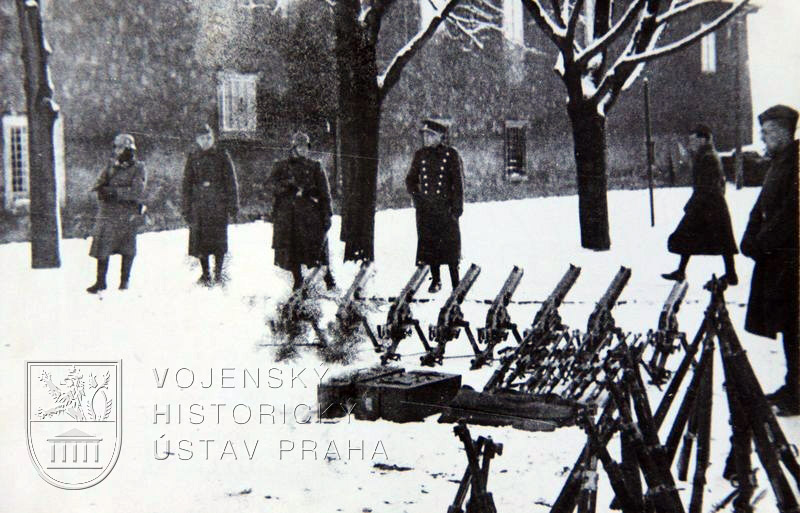
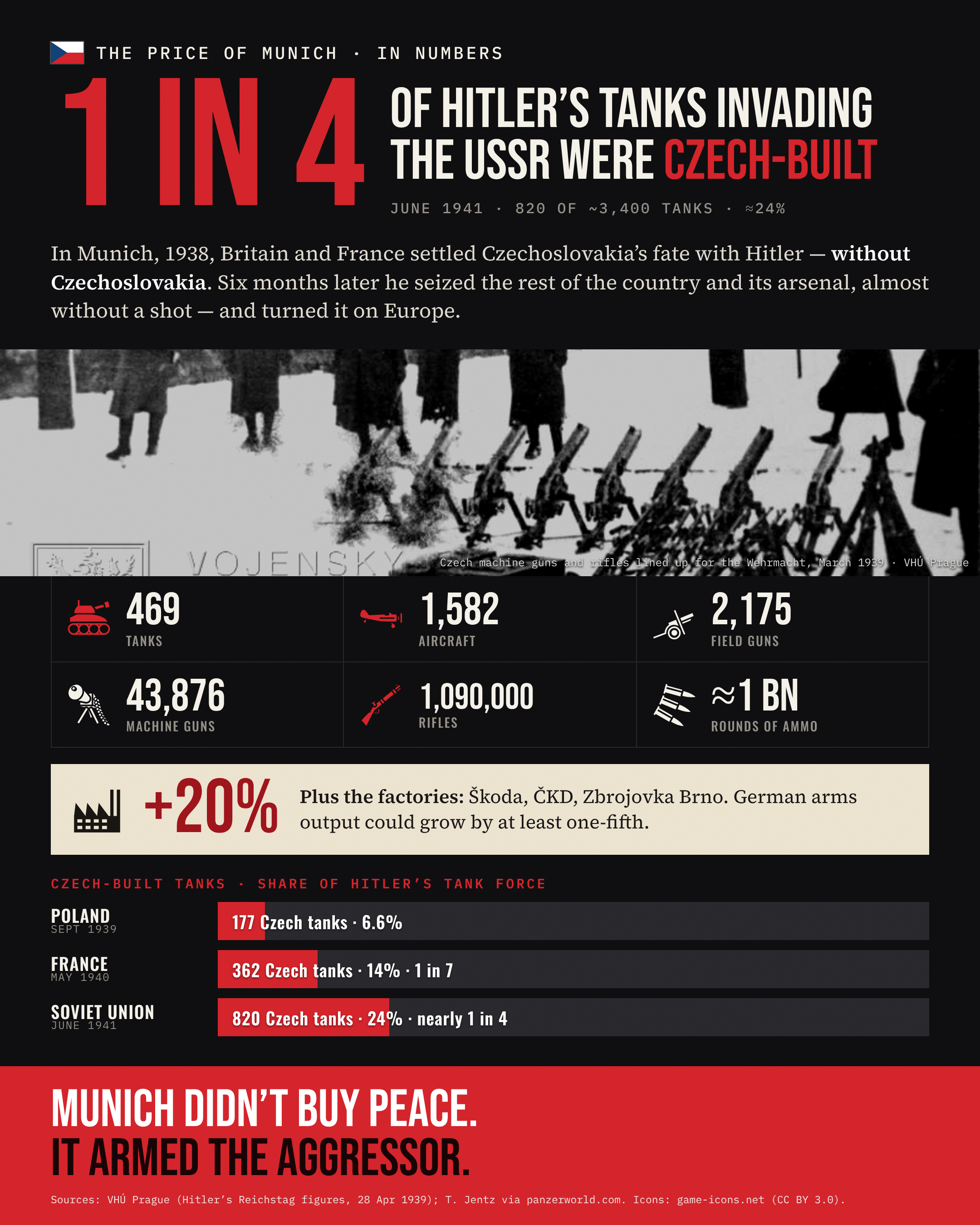
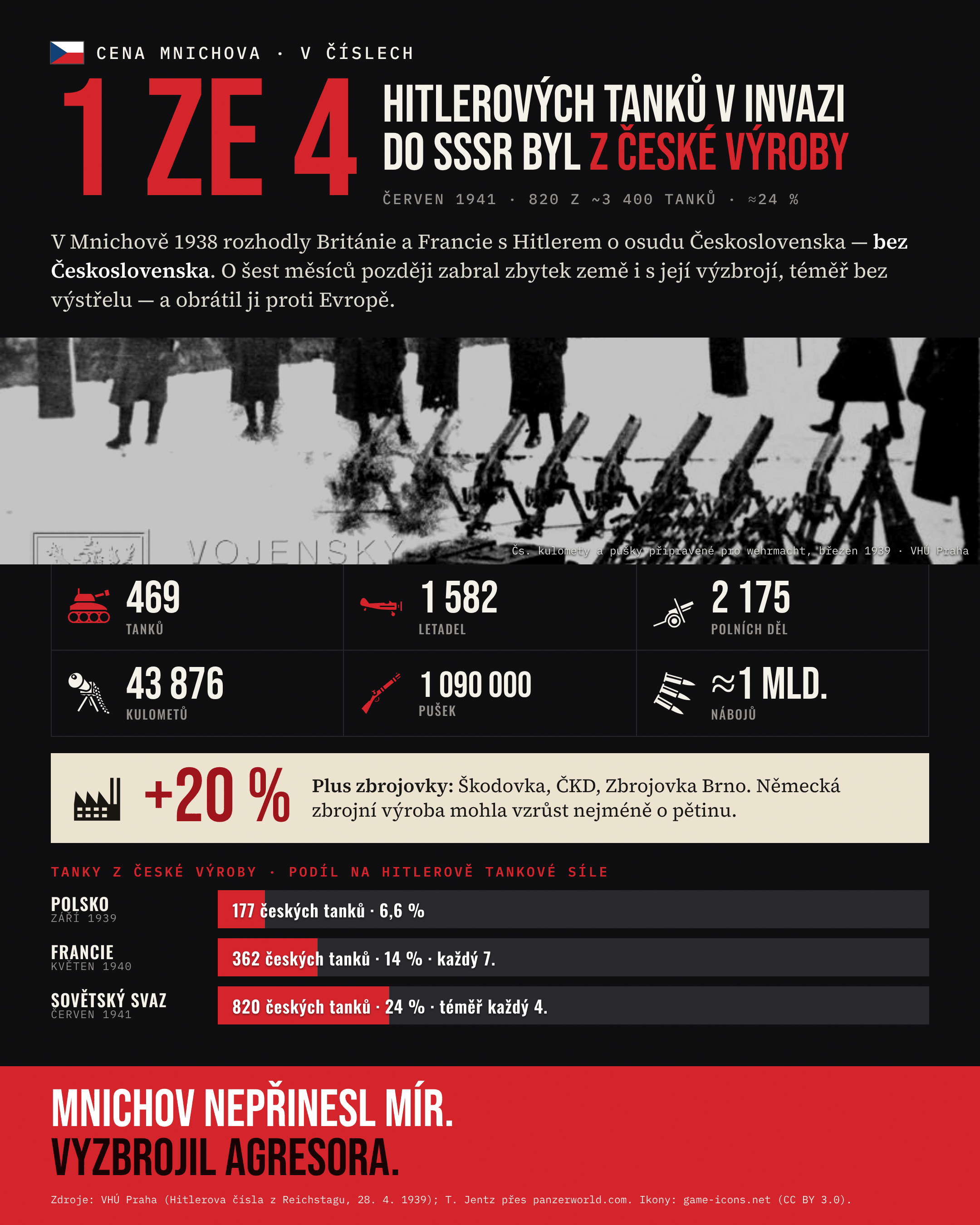
469 tanks.1,582 aircraft.1,090,000 rifles.
Seized by Hitler from Czechoslovakia in March 1939 — almost without a shot — six months after Britain and France settled the country’s fate with him in Munich, without Czechoslovakia at the table. Then turned against Poland, France and the Soviet Union.
Photo: Mladá Boleslav, March 1939 — Czech machine guns and rifles lined up for handover to the Wehrmacht. VHÚ Prague collection.
From Munich to Moscow
Mobilisation
Czechoslovakia orders general mobilisation. Its army mans the border fortifications, ready to fight.
Munich
Britain and France agree with Hitler and Mussolini: Czechoslovakia must give up its border regions — and with them its fortress line. Czechoslovakia, already mobilised, is not even invited. “About us, without us.”
Occupation
Hitler takes the rest of the Czech lands. An army equipped for 42 divisions and one of Europe’s biggest arms industries fall into his hands essentially intact.
Poland
Germany invades Poland — with Czech-built tanks in its armoured units.
France
The attack in the West. One German tank in seven is Czech-built.
Soviet Union
Operation Barbarossa. Nearly one German tank in four is Czech-built.
What Hitler took
Weapons of the Czechoslovak army, seized in Bohemia and Moravia
Figures from Hitler’s Reichstag speech, 28 April 1939; weapon counts as cited by the Military History Institute Prague (VHÚ).
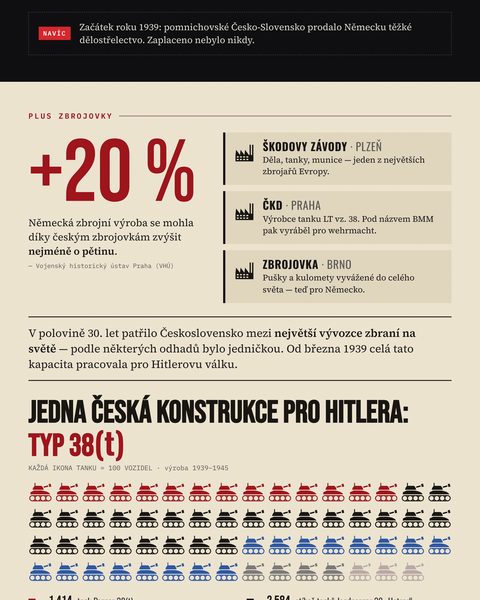
✎ Spotted an error? Suggest a correctionEarly 1939: rump Czechoslovakia sold Germany its heavy artillery. It was never paid for.
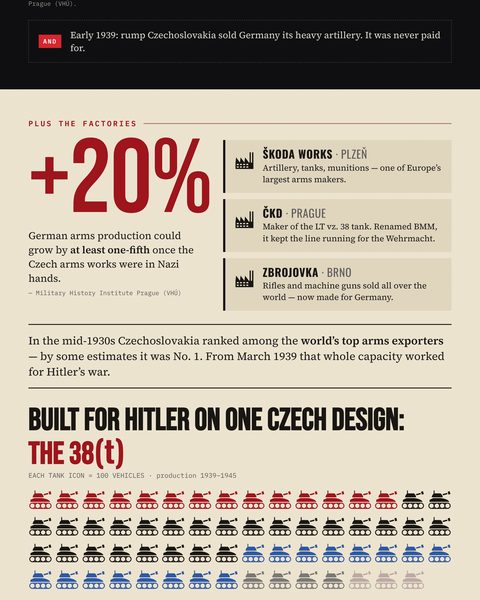
German arms production could grow by at least one-fifth once the Czech arms works were in Nazi hands.— Military History Institute Prague (VHÚ)
Škoda Works · Plzeň
Artillery, tanks, munitions — one of Europe’s largest arms makers.
ČKD · Prague
Maker of the LT vz. 38 tank. Renamed BMM, it kept the line running for the Wehrmacht.
Zbrojovka · Brno
Rifles and machine guns sold all over the world — now made for Germany.
In the mid-1930s Czechoslovakia ranked among the world’s top arms exporters — by some estimates it was No. 1. From March 1939 that whole capacity worked for Hitler’s war.
Built for Hitler on one Czech design:
the 38(t)
Each tank icon = 100 vehicles · production 1939–1945 · tap a type to highlight it
Our tanks. Their wars.
The Wehrmacht marked them (t) — for tschechisch: Czech. Pick a campaign to see the whole German tank force — and the Czech share in it.
Czech-built = Panzer 35(t) + 38(t) incl. command versions, at the start of each campaign. Tank strengths after T. Jentz (panzerworld.com). Panzer IV comparison: gun tanks only.
✎ Spotted an error? Suggest a correctionMobilisation 1938
Documentary from the Military History Institute Prague (VHÚ MOVIES, 2008, 18 min). The army Czechoslovakia mobilised in September 1938 — before Munich sent it home.
The handover, March 1939
Tap a photo to enlarge.
Download the flyers
Post them in comments, share them, print them. Every number is sourced below.
English

Česky

Flyers are free to share. Photos: VHÚ Prague collection; Bundesarchiv (CC BY-SA 3.0 DE). Icons: game-icons.net (CC BY 3.0).
Check every number
✎ Spotted an error? Suggest a correction- Přebírání čs. výzbroje německými silami, březen 1939VHÚ PrahaSeized weapons (Hitler’s figures), +⅕ arms output, 42 divisions, unpaid artillery
- Fall Gelb, 1940 — German tank strengthPanzerworld (after T. Jentz)Czech tanks in France: 118 Pz 35(t), 207 Pz 38(t), 37 command; Panzer IV: 280
- Barbarossa, 1941 — German tank strengthPanzerworld (after T. Jentz)Czech tanks in the USSR: 155 Pz 35(t), 625 Pz 38(t), 40 command; Panzer IV: 417
- Poland, 1939 — German tank strengthPanzerworld (after T. Jentz)Czech tanks in Poland: 112 Pz 35(t), 55 Pz 38(t), 10 command
- Panzerkampfwagen 38(t)de.wikipedia.orgProduction on the 38(t) design: Pz 38(t), Jagdpanzer 38, Marder III, Grille
- Czech Tanks Gave Nazis Early EdgeWarfare History Network (A. Blumberg)Czech tank shares in Poland, France and the USSR
- Panzer 38(t)HistoryNet (J. Guttman)Rommel’s 7th Panzer Division: 99 Panzer 38(t)
- German occupation of Czechoslovakiaen.wikipedia.orgAmmunition figures from Hitler’s Reichstag speech
- Czechoslovak arms exports in the 1930s (PDF)VŠE PrahaCzechoslovakia among the world’s top arms exporters
- Škoda Arms Exports in the 1930sSlavic ReviewŠkoda as a leading arms exporter of the 1930s
- O nás bez nás: osudové rozhodnutíNovinky.czMunich conference and mobilisation of 23 September 1938
- Mobilizace 1938 (2008)VHÚ MOVIES · YouTubeDocumentary video embedded on this page
Help us get it right
Spotted an inaccuracy, have a better source, or know something the site is missing? Send it here. We check every submission against the sources — accepted corrections are logged publicly below, credited to you if you wish.
Thank you
This is your reference number. We check every submission against the sources and, when it holds up, update the site and the flyers — and log the change publicly.
Corrections & updates
Munich didn’t buy peace.It armed the aggressor.
Czechoslovakia had mobilised and was ready to defend itself. Its allies chose to bargain with Hitler instead. Within months, Czech tanks were rolling into Poland — then France, then the Soviet Union. Feeding an aggressor someone else’s country doesn’t stop him. It arms him.